
Just because you can deliver deeper pressure with your feet doesn’t mean you should. Barefoot massage safety for the client and the therapist should always be the top priority.
For years, barefoot massage carried rigid stories about who could and couldn’t thrive under the bars. You might have heard that larger therapists will crush lighter clients, petite therapists cannot generate enough depth without muscling through, or hypermobile practitioners will wreck their joints under overhead bars.
Those old narratives missed the entire point of modern ashiatsu barefoot massage. Sustainable bodywork is not about brute strength, arbitrary weight restrictions, or pushing until a client taps out. It is about adaptability, understanding vectors of force, and letting gravity and supportive tools do the heavy lifting.
Whether you are tall, petite, recovering from an injury, or hypermobile, learning to adapt your barefoot massage technique creates a safe, deeply effective practice that outlasts industry burnout statistics.
The History of Ashiatsu Weight Rules for Barefoot Massage Safety and Why Training Evolved
In the early decades of westernized ashiatsu, training came with intense restrictions for barefoot massage safety. Back in the early 2000s, some classes required therapists to weigh under 135 pounds, hold a 90-degree pike pull-up for 60 seconds, and only work on clients who outweighed them by at least 100 pounds. Beginner and advanced two-footed strokes were often crammed into a single weekend, students brought mismatched portable tables, and instructors regularly watched tables tip or students lose control.
Those early rules came from genuine safety concerns, but they also baked exclusion and unnecessary rigidity into the profession.
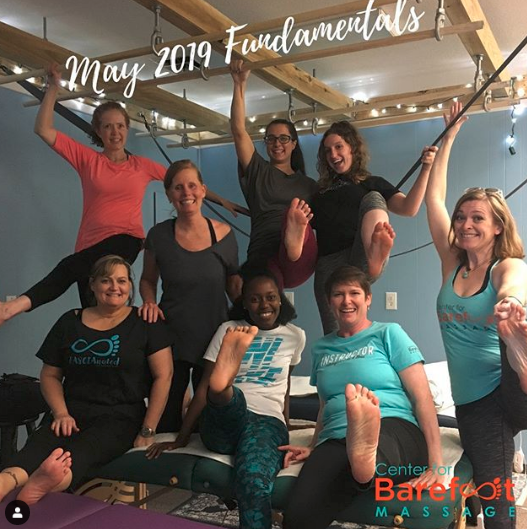
At the Center for Barefoot Massage (CBM), safety has shifted from gatekeeping body sizes to standardizing equipment and modernizing biomechanics. Classrooms feature heavy-duty commercial equipment, secure overhead bar and strap installations, and tiered coursework that builds skill before full weight transfer.
While having clients who outweigh you by 50 to 100 pounds makes effortless work easy to achieve, rigid weight limits have given way to adaptable, experience-based guidelines.
Therapist Size and the Pressure Myth Surrounding Barefoot Massage Safety: Working With Your Frame
Anyone can cause tissue trauma with uncontrolled force or poorly paced depth. True power comes from knowing when to sink, when to wait, and when the nervous system has received enough input.
When the Therapist Outweighs the Client
Therapists with more body mass have gravity on their side. The challenge is not holding back or exhausting yourself by hovering, it is modulating force.
-
Use the FasciAshi Strap: Redirect your center of mass and offload weight while gliding.
-
Shift Your Vectors: Adjust your angles so you are shearing and compressing tissue rather than dropping pure downward mass.
-
Give Weight and Wait: Deep fascial release relies on grip rather than fast glide. Slower, sustained contact signals safety to the client’s nervous system, allowing dense layers to soften naturally.
When the Client Outweighs the Therapist
Petite therapists often fall into the trap of overcompensating. Massage school often teaches therapists to lean in with their body weight, but standard tables rarely lower enough for shorter practitioners to gain true mechanical advantage. Under the bars, petite therapists might catch themselves pushing up into the ceiling bars with their shoulders to force artificial depth.
Pushing through your upper body burns out your shoulders and triggers defensive bracing in your client’s tissue. Working with a smaller foot distributes load through a smaller contact area, meaning you naturally deliver surprising depth without forcing it. The real skill is slowing down, catching the first available layer of tissue, and letting gravity sink in gradually instead of muscling your way down.
Hypermobility and Joint Stability Under the Bars
An increasing number of massage therapists live with joint hypermobility, Ehlers-Danlos Syndrome (EDS), or co-occurring autonomic conditions. For a hypermobile therapist, traditional hands-on table massage often requires constant bending, sitting, and pushing, postures that demand high core exertion while placing shear stress across loose wrists and finger joints.
Standing upright under overhead bars can be a career saver, but extra range of motion without stability leads straight to fatigue and strain, risking barefoot massage safety for both the client and the practitioner.
Hypermobility Checkpoints for the Barefoot Therapist
At the Bars: Use an active, stabilizing grip with soft elbows rather than hanging passively from loose connective tissue
At the Core: Keep ribs stacked cleanly over hips, avoiding the urge to flare the chest or hyperextend the low back when reaching overhead
At the Tissue: Steer clear of heavy backward dragging traction, using your diagonal strap to offload downward load and protect vulnerable joint capsules
Hypermobile therapists thrive in barefoot massage by focusing on joint-over-joint alignment, relying on the FasciAshi Strap as a stable, floating wall of support, and maintaining active muscular tension rather than sinking into end-range joint locks.
Why Movement Variability Protects Your Body and Fascia
Modern fascial research shows that connective tissue is metabolically active and richly innervated. Fascia stays hydrated, functional, and responsive when exposed to varied, multi-planar mechanical inputs (Avila González et al., 2018). When therapists repeat the exact same routine on every client, tissue adaptability drops for both parties.
Movement variability is essential for neuromuscular health and joint longevity (Stergiou et al., 2016; van Emmerik & van Wegen, 2000):
-
Mix Modalities Mindfully: Combine barefoot strokes with hands-on work or myofascial tools when you need to change your working posture.
-
Vary Client Types: Exclusively working on clients twice your size builds habits of pushing, while exclusively working on smaller bodies trains you to withhold weight. Working across different body types keeps your movement vocabulary diverse and adaptable.
-
Expand Your Stroke Repertoire: Advance into specialized coursework like Barefoot Matwork or clinical track classes to learn new vectors that do not tax the same movement patterns day after day.

Build a Sustainable Practice With Barefoot Massage Safety Through FasciAshi
A long massage career is built on knowing your physics, honoring your limits, and choosing techniques that fit your body. When you step away from brute force and embrace biomechanical adaptability, you can deliver profound myofascial work without putting your own joints on the line, all while employing great barefoot massage safety!
Ready to learn how gravity and proper mechanics can transform your daily practice? Check our upcoming training schedule to find a hands-on workshop near you, or start building your foundation in FasciAshi Fundamentals.
Just because you can deliver deeper pressure with your feet doesn’t mean you should. Barefoot massage safety for the client and the therapist should always be the top priority. For years, barefoot massage carried rigid stories about who could and couldn’t thrive under the bars. You might have heard that larger therapists will crush lighter clients, petite therapists cannot generate…